
تصویر: اینفوگرافیک فارسی با پسزمینه تیره درباره استفاده از هوش مصنوعی در گمرک آمریکا، همراه با تصاویر بندر و کانتینرها، نمودار سیستم…
Uploaded Image
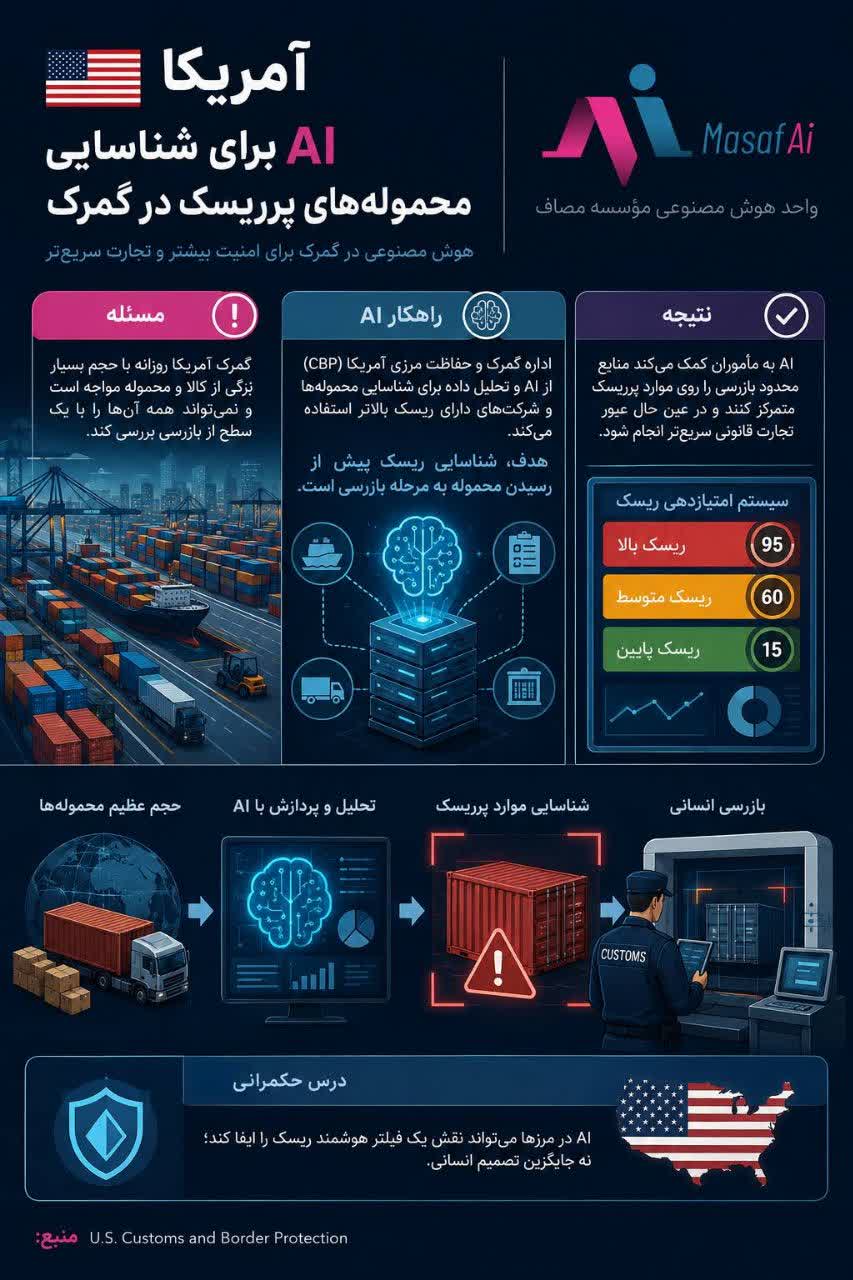
Transcribed Text
The Persian-language infographic (attributed to 'MasafAi', the AI unit of Iran's Masaf Institute) claims that U.S.
Full analysis The complete summary ⌄
The Persian-language infographic (attributed to 'MasafAi', the AI unit of Iran's Masaf Institute) claims that U.S. Customs and Border Protection (CBP) uses artificial intelligence and data analytics to identify higher-risk cargo and companies before physical inspection, so that scarce inspection resources are concentrated on high-risk consignments while legitimate trade flows faster, with AI acting as a risk filter rather than a replacement for human decision-making. Targeted research against primary U.S. government sources (CBP.gov, DHS.gov, CBP Directive 1450-030, GAO reports) confirms the substance of these core claims: CBP handles very large daily cargo volumes, operates risk-based advance targeting (Automated Targeting System, National Targeting Center, Container Security Initiative), has publicly documented AI/ML deployments for cargo screening and trade enforcement (including a 2025 two-year contract with Altana's AI platform), and formally requires human review of AI outputs, prohibiting AI as the sole basis for enforcement action. Two elements are not verifiable: (a) the specific numeric risk scores displayed (95 / 60 / 15) — CBP does classify shipment risk scores as low, medium and high, but the actual numeric thresholds are law-enforcement sensitive and not published, so the figures appear illustrative rather than sourced; and (b) the generic attribution 'Source: U.S. Customs and Border Protection' with no specific document, page or date. A further nuance (overstatement rather than falsehood): much of CBP's long-standing cargo targeting is a weighted-rules mathematical model (ATS) rather than modern machine learning; labelling the whole pipeline simply 'AI' compresses a more layered reality. Presentation is calm, low-emotion and non-polemical, with no detectable anti-U.S. or pro-regime framing in the extracted text, but the publisher's institutional profile (a sanctioned pro-Iranian-government cultural/propaganda organisation, per OpenSanctions) warrants provenance caution even where content is accurate.
What checked out (7)
- CLAIM 1 — 'U.S. customs faces a very large daily volume of goods and cannot inspect everything at one level of inspection.' VERIFIED. CBP's own 'On a Typical Day' statistics for FY2024 report approximately 88,582 truck, rail and sea containers, 105,103 entries of merchandise and USD 9.2 billion of imported goods processed per day; FY2025 figures show 137,217 entries of merchandise and USD 9.8 billion of imports per day. Primary source: https://www.cbp.gov/newsroom/stats/typical-day-fy2024 and https://www.cbp.gov/newsroom/stats/typical-day-fy2025
- CLAIM 2 — 'CBP uses AI and data analytics to identify shipments and companies with higher risk.' VERIFIED. DHS states that CBP uses AI to help screen cargo at ports of entry and to enhance threat awareness at the border, with AI models identifying objects in imagery and sending real-time anomaly alerts to operators (https://www.dhs.gov/ai/using-ai-to-secure-the-homeland). CBP's own AI spotlight describes deploying AI models to assist officers screening for contraband and anomaly detection in cargo conveyances, citing increased throughput and reduced false positives (https://www.cbp.gov/newsroom/spotlights/artificial-intelligence-harness-key-insights-cbp). In October 2025 CBP signed a two-year contract to pilot Altana's AI platform for real-time trade enforcement, forced-labour and counternarcotics risk detection (https://altana.ai/resources/cbp-selects-altana-product-passports-traceability; https://finance.yahoo.com/news/us-customs-altana-partner-ai-103904384.html).
- CLAIM 3 — 'The aim is to identify risk before the consignment reaches the inspection stage (pre-arrival targeting).' VERIFIED. CBP states it uses automated targeting tools to identify containers posing potential risk based on advance information and strategic intelligence, and to prescreen containers before they are laden abroad under the Container Security Initiative (https://www.cbp.gov/border-security/ports-entry/cargo-security/csi/csi-brief). The Automated Targeting System is described by DHS as a decision-support tool comparing traveller, cargo and conveyance information against law-enforcement and intelligence data using risk-based rules (https://www.dhs.gov/sites/default/files/publications/privacy-pia-cbp006-ats-may2021.pdf).
- CLAIM 4 — 'AI helps officers concentrate limited inspection resources on high-risk cases while legitimate trade moves faster.' VERIFIED. CBP has publicly stated that the Altana/Global Business Identifier Product Passport approach enables more efficient border processing while allowing officers to focus enforcement on higher-risk shipments (https://www.just-style.com/news/us-customs-altana-partner-on-ai-powered-product-passports/). GAO similarly documents that CBP's layered, risk-based strategy is designed to focus resources on potentially risky containers while allowing other cargo to proceed without unduly disrupting commerce (https://www.gao.gov/assets/a271546.html).
- CLAIM 5 — 'Risk is triaged into high / medium / low bands feeding an inspection decision.' VERIFIED as to structure. GAO reports that CBP classifies ATS risk scores from its weight set as low, medium or high risk, and that the score determines, in part, actions taken by CBP targeters at the ports; high-risk containers are to be inspected (https://www.gao.gov/products/gao-13-9; https://www.gao.gov/assets/a246126.html).
- CLAIM 6 — 'AI at the border acts as an intelligent risk filter, not a substitute for human decision-making.' VERIFIED. CBP Directive No. 1450-030 (AI Operations and Governance, redacted public version) states that all CBP personnel using AI in official duties should review and verify AI-generated content before it is shared, implemented or acted upon, and that personnel remain accountable for outputs; reporting on the directive notes AI cannot be used as a 'sole basis' for a law-enforcement action (https://www.cbp.gov/sites/default/files/2025-11/cbp_directive_no._1450-030_ai_operations_and_governance_redacted_1.pdf; https://www.fastcompany.com/91433381/cbp-ai-trump-border-immigration-surveillance). DHS/CBP privacy documentation also characterises ATS as a 'decision support tool' (https://dhs.gov/publication/automated-targeting-system-ats-update).
- CLAIM 7 — 'Human inspection is the final stage of the pipeline (volume → AI analysis → high-risk identification → human inspection).' VERIFIED as a fair simplification, consistent with GAO's description of targeters reviewing shipment data and deciding on documentary review or physical examination (https://www.gao.gov/products/gao-13-9) and with CBP's human-review requirement in Directive 1450-030.
Disputed claims 2 claims ⌄
- DISPUTED / OVERSTATED (not false) — The framing that CBP cargo risk identification is essentially 'AI'. GAO documentation describes the Automated Targeting System as a complex mathematical model using weighted rules to assign risk scores to arriving cargo shipments (https://www.gao.gov/assets/a279734.html; https://www.gao.gov/assets/a311027.html), i.e. rules-based analytics rather than machine learning; documented AI/ML use is concentrated in image/anomaly detection, supply-chain graph analytics and newer pilots. The infographic's label is therefore a simplification that overstates AI's current share of the targeting pipeline.
- DISPUTED / CONTEXT MISSING (not false) — The graphic presents the risk-scoring system as a transparent, quantified scale. Independent oversight and civil-liberties documentation notes that ATS scoring logic, rule weights and redress mechanisms are opaque to affected parties (https://www.dhs.gov/sites/default/files/publications/privacy-pia-cbp006-ats-may2021.pdf; https://www.federalregister.gov/documents/2007/08/06/E7-15197/privacy-act-of-1974-us-customs-and-border-protection-automated-targeting-system-system-of-records). This omission is material to the graphic's 'governance lesson'.
Unverified claims 4 claims ⌄
- CLAIM 8 — The specific numeric risk scores shown in the graphic ('High risk — 95', 'Medium risk — 60', 'Low risk — 15'). UNVERIFIED. No primary CBP or DHS publication located discloses the numeric scale, thresholds or band values of ATS/NTC risk scores; GAO confirms only the existence of weighted-rule numerical scores classified as low/medium/high, and ATS rule weights and thresholds are treated as law-enforcement sensitive and are redacted in public documents (https://www.gao.gov/assets/gao-13-9.pdf; https://www.dhs.gov/sites/default/files/2024-12/24_1210_priv-pia-cbp-automatedtargetingsystem006-appendixupdate.pdf). These numbers should be read as illustrative design values, not published CBP data. Not marked False: absence of public disclosure is not evidence of contradiction.
- CLAIM 9 — The attribution 'Source: U.S. Customs and Border Protection'. UNVERIFIED as a specific citation. The general propositions are consistent with CBP and DHS material, but no single CBP document, URL, publication date or dataset is identified in the image, so the specific provenance of the visual, the score bands and the four-stage pipeline diagram cannot be traced to any CBP product. This is a sourcing-transparency deficiency rather than a factual error.
- CLAIM 10 — Implicit claim that AI (as opposed to rules-based analytics) is the operative engine identifying 'companies' as well as shipments as high-risk across CBP's cargo stream. PARTIALLY UNVERIFIED. Entity-level (company/supplier) risk analytics are documented for the Altana pilot and forced-labour/counternarcotics use cases (https://www.msn.com/en-us/money/markets/exclusive-cbp-taps-altana-s-ai-for-trade-enforcement/ar-AA1PymXb), but the extent to which AI/ML — rather than legacy weighted rules — now drives routine, agency-wide cargo risk scoring is not established in public primary sources.
- CLAIM 11 — Any implied claim about current effectiveness magnitude (e.g. that AI materially improves interdiction or clearance speed in measured terms). UNVERIFIED. CBP asserts efficiency and false-positive benefits (https://www.cbp.gov/newsroom/spotlights/artificial-intelligence-harness-key-insights-cbp) but no independent, dated evaluation with published metrics was located; GAO has historically criticised CBP for insufficient regular assessment of its cargo targeting system (https://www.gao.gov/products/gao-13-9).
Sources & how we checked Search journal, source grades, confidence ⌄
Confidence
Moderate-High (78%) — Confidence is high for the four core substantive claims because they are corroborated by multiple dated U.S. federal primary sources (CBP statistics pages, CBP Directive No. 1450-030, DHS AI pages, GAO reports) that directly address CBP's risk-based cargo targeting, its AI deployments and its human-oversight requirements. Confidence is reduced by three factors: (1) the graphic's specific numeric risk bands cannot be checked against any public CBP disclosure, because ATS scoring logic and thresholds are law-enforcement sensitive and redacted, so those figures remain Unverified rather than confirmed or refuted; (2) the independent oversight literature on cargo targeting is largely from 2008–2013, leaving a currency gap on how much of today's pipeline is genuinely machine learning versus legacy weighted rules; and (3) verification relied on search-result extracts of several primary PDFs rather than full document review, and the image itself was assessed from a transcription, so fine-grained visual details could not be validated. Fast-moving items (AI contracts, pilot scope, inventory entries) are dated to their sources and may change; no claim was rated False, in line with the stated evidentiary guardrail.
Search journal
CBP artificial intelligence cargo targeting high-risk shipments
- https://www.cbp.gov/border-security/ports-entry/cargo-security/csi/csi-brief
- https://www.dhs.gov/ai/using-ai-to-secure-the-homeland
- https://www.cbp.gov/newsroom/spotlights/artificial-intelligence-harness-key-insights-cbp
- https://datainnovation.org/2025/02/cbp-should-leverage-ai-not-more-staff-to-manage-the-surge-in-inspections...
National Targeting Center CBP risk scoring cargo AI
- https://www.dhs.gov/sites/default/files/2024-12/24_1210_priv-pia-cbp-automatedtargetingsystem006-appendixupdate.pdf
- https://en.wikipedia.org/wiki/National_Targeting_Center
CBP AI inventory use cases trade enforcement 2025
- https://www.cbp.gov/sites/default/files/2025-11/cbp_directive_no._1450-030_ai_operations_and_governance_red...
- https://www.fastcompany.com/91433381/cbp-ai-trump-border-immigration-surveillance
- https://fedscoop.com/customs-border-protection-ai-tools/
- https://www.nextgov.com/artificial-intelligence/2026/01/law-enforcement-leading-dhs-use-case-ai/411063/
CBP Automated Targeting System ATS cargo risk score
- https://www.gao.gov/products/gao-13-9
- https://www.dhs.gov/sites/default/files/publications/privacy-pia-cbp006-ats-may2021.pdf
- https://www.federalregister.gov/documents/2007/08/06/E7-15197/privacy-act-of-1974-us-customs-and-border-pro...
CBP trade statistics daily shipments value cargo processed per day
- https://www.cbp.gov/newsroom/stats/typical-day-fy2024
- https://www.cbp.gov/newsroom/stats
- https://www.cbp.gov/newsroom/stats/trade
CBP directive 1450-030 AI operations governance human oversight
- https://www.cbp.gov/sites/default/files/2025-11/cbp_directive_no._1450-030_ai_operations_and_governance_red...
- https://www.dhs.gov/sites/default/files/2025-09/25_0926_cio_dhs_ai_strategy_for_omb_m-25-21_508.pdf
DHS AI use case inventory CBP cargo targeting machine learning
- https://www.dhs.gov/archive/news/2024/12/16/ai-dhs-deep-dive-our-use-case-inventory
- https://dhs.gov/ai/use-case-inventory/cbp
- https://dhs.gov/ai
Automated Targeting System risk score weighted rules cargo ATS-N
- https://www.dhs.gov/xlibrary/assets/privacy/privacy_pia_cbp_ats006b.pdf
- https://en.wikipedia.org/wiki/Automated_Targeting_System
- https://www.gao.gov/assets/a271546.html
"On a typical day" CBP FY2024 processed truck rail sea containers value imports
- https://www.cbp.gov/newsroom/stats/typical-day-fy2024
- https://www.cbp.gov/newsroom/stats/typical-day-fy2025
- https://www.cbp.gov/newsroom/stats/typical-day-fy2023
Axios CBP Altana AI trade enforcement October 2025 targeting risky shipments
- https://altana.ai/resources/cbp-selects-altana-product-passports-traceability
- https://finance.yahoo.com/news/us-customs-altana-partner-ai-103904384.html
- https://www.just-style.com/news/us-customs-altana-partner-on-ai-powered-product-passports/
- https://www.msn.com/en-us/money/markets/exclusive-cbp-taps-altana-s-ai-for-trade-enforcement/ar-AA1PymXb
CBP AI rules human review required decisions Fast Company directive
- https://www.fastcompany.com/91433381/cbp-ai-trump-border-immigration-surveillance
- https://tax.thomsonreuters.com/blog/ai-and-reasonable-care-in-trade-compliance-what-professionals-actually-need/
- https://www.mondaq.com/unitedstates/international-trade-investment/1766374/even-ai-needs-a-license-know-whe...
GAO CBP Automated Targeting System assigns risk score cargo shipments national security weight rules
- https://www.gao.gov/assets/gao-13-9.pdf
- https://www.gao.gov/assets/a279734.html
- https://www.gao.gov/assets/a311027.html
- https://www.gao.gov/assets/a246126.html
Masaf Institute Raefipour موسسه مصاف
- https://www.opensanctions.org/entities/NK-nDbRjg7hrfGRt7B9bmF9zU/
- https://en.wikipedia.org/wiki/Ali-Akbar_Raefipour
Article metrics
The article we checked Full text as retrieved ⌄
Read next
Get email updates
Our latest reporting and fact checks in your inbox. Free, and one click to leave.