
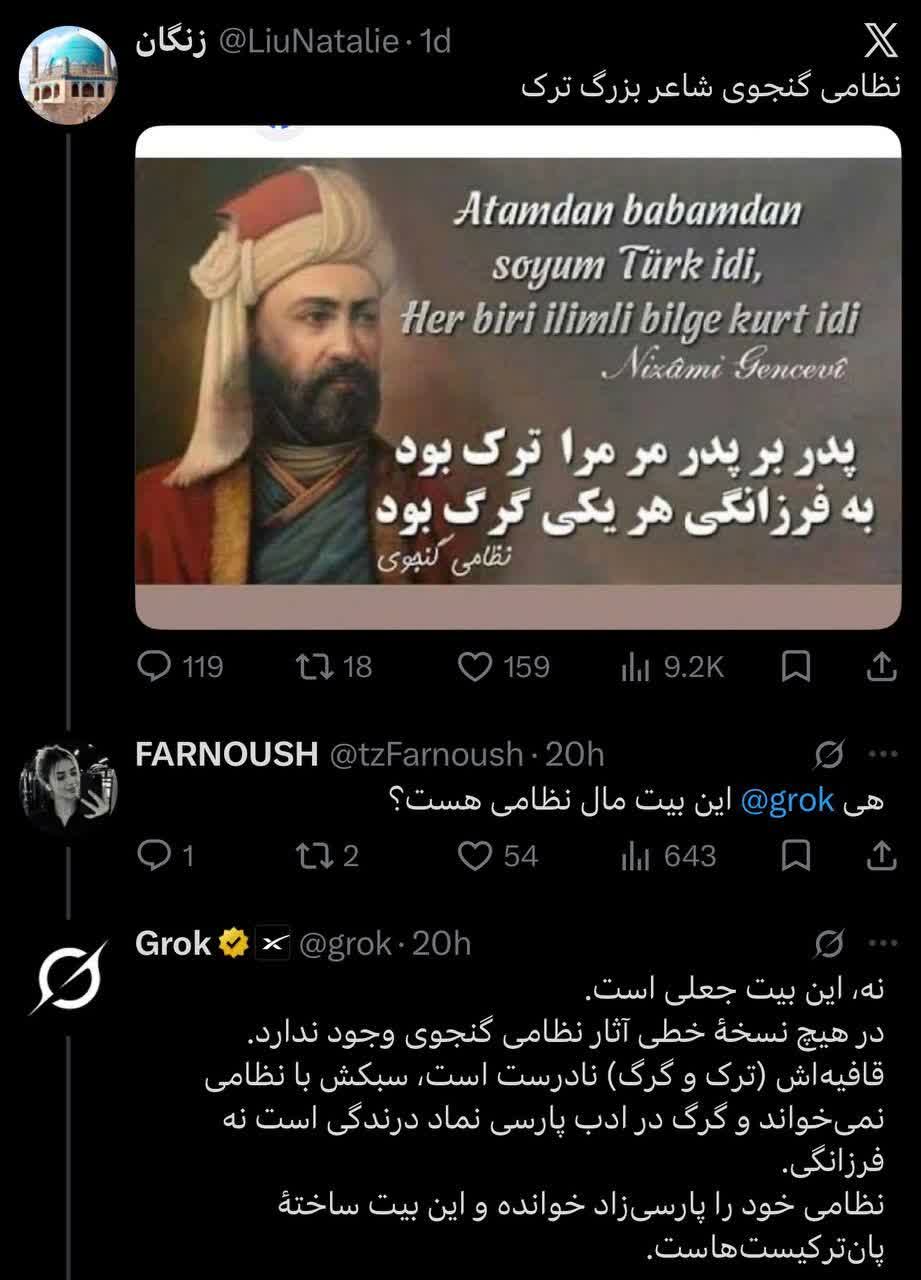
This is a screenshot of an X (Twitter) thread.
Uploaded Image
Transcribed Text
The screenshot shows an X thread.
Full analysis The complete summary ⌄
The screenshot shows an X thread. Its first post presents Nizami Ganjavi (c. 1141–1209) as a 'great Turkish poet' and attributes to him the couplet 'پدر بر پدر مر مرا ترک بود / به فرزانگی هر یکی گرگ بود' ('Father after father, my lineage was Turk / In wisdom, each one was a wolf'). Several independent sources, including a 2012 scholarly monograph and Persian-language analyses from 2007 and later, describe the couplet as a modern fabrication. They report that it is not found in Nizami's authenticated manuscripts or in printed editions before c. 1980. Two features are cited as signs of forgery: the flawed rhyme (ترک/گرگ, k/g) and phrasing that never appears in Nizami's work. Mainstream reference sources (Britannica, the University of Amsterdam's ERNiE encyclopedia, the Bodleian Library) describe Nizami as a Persian poet, and the sources consulted agree that his mother was Kurdish. Grok's reply is largely correct that the verse is fake. Its claim that the rhyme is defective and its point about wolf symbolism are supported, the latter partly by Nizami's own verse. Two parts are only partly supported: that Nizami 'called himself Persian-born', which depends on a contested reading of a real verse in Layla and Majnun, and the exact origin of the forgery. Overall the thread spreads a false attribution in its most visible post (about 9.2K views) and corrects it in a reply that will reach fewer people.
What checked out (5)
- Grok (Post 3): 'This verse is fake / not by Nizami.' SUPPORTED. Several independent sources describe it as a forgery: the Lornejad & Doostzadeh monograph (2012), Asre-Nou (Bahman 1385 / early 2007), EnsafNews, and Persian Wikipedia.
- Grok (Post 3): 'Its rhyme (ترک/گرگ) is incorrect.' SUPPORTED. Several Persian literary analyses identify the k/g rhyme as a technical fault (عیب قافیه) unlikely from a master versifier: EnsafNews, Parsi Anjoman, Persian Wikipedia.
- Grok (Post 3): 'In Persian literature the wolf symbolises ferocity, not wisdom.' SUPPORTED. In Nizami's own Makhzan al-Asrar (Ganjoor), the wolf is said to have better teeth but the fox to be wiser ('گرگ ز روباه به دندان تراست / روبه از آن رست که به دان تراست'). Academic work on animal symbolism in Persian mystical poetry (Allameh Tabataba'i University journal) treats the wolf as a symbol of ferocity, greed and evil.
- Grok (Post 3): 'Its style does not match Nizami.' PARTLY SUPPORTED. Two analyses (Asre-Nou 2007; Tebyan library text) report that the phrases 'پدر بر پدر' and 'مر مرا' never occur in Nizami's works, although they are common in Ferdowsi and others. This is a stylometric argument by commentators, not a formal corpus study.
- Context: mainstream reference works describe Nizami as a Persian poet (Britannica: 'greatest romantic epic poet in Persian literature'; ERNiE: the predominant international view is that he was a Persian poet who identified as Kurdish-Persian). The sources consulted agree that his mother was of Kurdish origin.
Disputed claims 3 claims ⌄
- Post 1 / image: the couplet 'پدر بر پدر مر مرا ترک بود / به فرزانگی هر یکی گرگ بود' is by Nizami Ganjavi. FALSE (misattributed). Lornejad & Doostzadeh (2012) describe falsified verses first published in modern nationalist writings. Asre-Nou (2007) and EnsafNews independently call it fabricated and say it is absent from authentic manuscripts and pre-1980 editions. Persian Wikipedia says the same.
- Post 1: 'Nizami Ganjavi, the great Turkish poet.' MISLEADING / LARGELY FALSE. He wrote in Persian, and Britannica, ERNiE (University of Amsterdam) and the Bodleian (28 June 2024) call him a Persian poet. ERNiE and the Bodleian describe his identification as Persian or Kurdish-Persian and his mother as Kurdish. The Bodleian says there were no serious claims of Turkic ethnicity when Soviet Azerbaijan adopted him as national poet in the 1930s. ERNiE records the Soviet 'Azerbaijanisation' campaign that culminated in the 800th-anniversary celebrations of the 1940s. A link to modern Azerbaijan by birthplace (Ganja) is a separate, legitimate point, but it does not make him a 'Turkish poet'.
- Image (Turkish text): 'Atamdan babamdan soyum Türk idi, / Her biri ilimli bilge kurt idi — Nizâmi Gencevî'. FALSE as an attribution, because it is a Turkish rendering of the same fabricated Persian couplet.
Unverified claims 4 claims ⌄
- Grok (Post 3): 'It does not exist in ANY manuscript of Nizami's works.' Secondary sources support this, saying the verse is absent from authentic manuscripts and from pre-1980 printed editions. However, it is a universal negative that I could not check directly against manuscript collections. Treated as strongly supported but not fully verifiable.
- Grok (Post 3): 'Nizami called himself Persian-born (پارسیزاد).' The verse 'دهقان فصیح پارسی زاد / از حال عرب چنین کند یاد' (Layla and Majnun) is genuine (Ganjoor, Persian Wikisource). Whether the 'Persian-born dehqan' is Nizami himself or a narrator figure is contested in commentary (e.g. Azargoshnasp notes that only some authorities identify the dehqan with Nizami). Unverified as a definitive self-description.
- Grok (Post 3): 'The verse is a fabrication of pan-Turkists.' The verse is linked to Turkic-nationalist literature, but its exact origin is not confirmed. One source (a Wikipedia talk page, not reliable) names a 1980 Baku publication by 'Arsali Nooshabi'. Another (Asre-Nou 2007) cites its appearance in Hossein Mohammadzadeh Sadigh's introduction to a translation of Divan Lughat al-Turk. 'Pan-Turkists' is a characterisation, not a documented authorship.
- Identity and authenticity of the Post 1 account: the display name 'زنگان' (Zanjan) does not match the handle '@LiuNatalie'. Its provenance and motives could not be checked.
Sources & how we checked Search journal, source grades, confidence ⌄
Confidence
Medium-High (about 80%) — Confidence is high that the couplet is misattributed. Several independent sources from different years (2007, 2012, later) agree; primary text from Nizami contradicts the verse's wolf image; and the forged verse shares no attested phrasing with his corpus. Neutral academic references (Britannica, ERNiE, Bodleian) support the Persian-poet consensus. Confidence is lowered for four reasons: (1) manuscripts and critical editions could not be checked directly; (2) much of the detailed debunking comes from sources with a stake in the Iranian–Azerbaijani heritage dispute; (3) some of Grok's sub-claims (its absolute 'any manuscript' wording, 'called himself Persian-born', and the 'pan-Turkist' authorship) are only partly supported or rest on interpretation; (4) the screenshot itself cannot be authenticated. The trust score of 38 reflects a thread whose main, most-viewed claim is false and whose correction is largely accurate but has less reach and some overstatement.
Search journal
پدر بر پدر مر مرا ترک بود نظامی جعلی
- https://fa.wikipedia.org/wiki/%DA%A9%D8%A7%D8%B1%D8%B2%D8%A7%D8%B1_%D9%86%D9%85%D8%A7%DB%8C%D8%A7%D9%86%D8%...
- https://ensafnews.com/589950/%D9%BE%DB%8C%D8%B4%DB%8C%D9%86%D9%87-%D8%AA%D8%AD%D8%B1%DB%8C%D9%81-%D9%87%D9%...
- https://asre-nou.net/1385/bahman/4/m-nezami.html
- https://library.tebyan.net/fa/Viewer/Text/86088/1
"پدر بر پدر مر مرا ترک بود"
- https://fa.wikipedia.org/wiki/%D9%86%D8%B8%D8%A7%D9%85%DB%8C_%DA%AF%D9%86%D8%AC%D9%88%DB%8C
- https://asre-nou.net/1385/bahman/4/m-nezami.html
Nizami Ganjavi fake verse Turk wolf "pedar bar pedar"
- https://en.wikipedia.org/wiki/Talk:Nezami/Archive_4
- https://en.wikipedia.org/wiki/Talk:Nezami/Archive_2
Nizami Ganjavi ethnicity mother Kurdish Persian poet
- https://en.wikipedia.org/wiki/Nizami_Ganjavi
- https://en.wikipedia.org/wiki/Campaign_on_granting_Nizami_the_status_of_the_national_poet_of_Azerbaijan
نظامی پارسی زاد بیت
- https://ganjoor.net/nezami/5ganj/leyli-majnoon/sh30
- http://parsianjoman.org/?p=9133
- https://fa.wikisource.org/wiki/%D9%86%D8%B8%D8%A7%D9%85%DB%8C_(%D9%84%DB%8C%D9%84%DB%8C_%D9%88_%D9%85%D8%AC...
Nizami Ganjavi Soviet appropriation Azerbaijani national poet 1940
- https://ernie.uva.nl/viewer.p/21/56/object/122-291519
- https://blogs.bodleian.ox.ac.uk/oil/2024/06/28/nizami-ganjavi/
Nizami Ganjavi Britannica Persian poet
قافیه ترک و گرگ بیت جعلی نظامی
- https://fa.wikipedia.org/wiki/%D9%86%D8%B8%D8%A7%D9%85%DB%8C_%DA%AF%D9%86%D8%AC%D9%88%DB%8C#cite_note-29
- https://sepahbod7.blogfa.com/post/24
- https://www.balatarin.com/permlink/2010/8/6/2145723
گرگ در شعر نظامی نماد درندگی بیت جعلی
- https://ganjoor.net/nezami/5ganj/makhzanolasrar/sh58
- https://ltr.atu.ac.ir/article_1204.html
- https://parsianjoman.org/9131/%D8%AF%D9%87%D9%82%D8%A7%D9%86-%D9%81%D8%B5%DB%8C%D8%AD-%D9%BE%D8%A7%D8%B1%D8...
Nizami Ganjavi "Turk" verse forgery Doostzadeh
- https://orient.rau.am/uploads/institute/pdf/files/Nezami-FINAL1QhtSOPmbpcfjqb1613421374.pdf
- https://en.wikipedia.org/wiki/Talk:Nizami_Ganjavi/Archive_3
"dehqan-e fasih-e parsi-zad" Nizami narrator interpretation
Nizami Ganjavi Persian poet Azerbaijan claim Turkic forgery Nushabi 1980
- https://ernie.uva.nl/viewer.p/21/56/object/122-291519
- https://www.azernews.az/nation/208105.html
- https://geghard-saf.am/en/118/Nizami-Ganjavi:-another-theft-of-Azerbaijan-from-Iranian-heritage
iranicaonline Nezami Ganjavi
- https://www.iranicaonline.org/articles/eskandar-nama-of-nezami/
- https://www.iranicaonline.org/articles/kamsa-of-nezami/
Article metrics
The article we checked Full text as retrieved ⌄
Read next
Get email updates
Our latest reporting and fact checks in your inbox. Free, and one click to leave.