
Iran Update
Uploaded Image
Transcribed Text
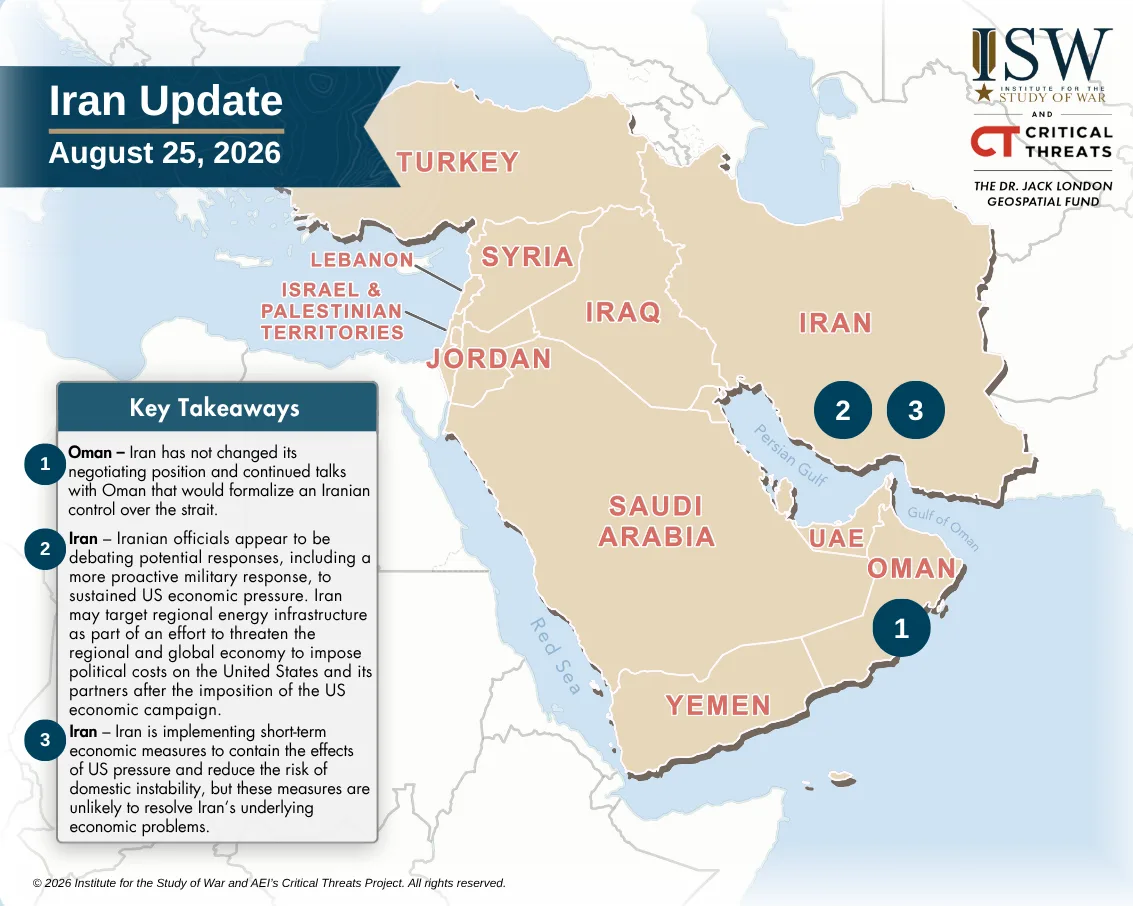
The image is an authentic-looking daily 'Iran Update' map product of the Institute for the Study of War (ISW) and AEI's Critical Threats Project (CTP), dated 25 August 2026.
Full analysis The complete summary ⌄
The image is an authentic-looking daily 'Iran Update' map product of the Institute for the Study of War (ISW) and AEI's Critical Threats Project (CTP), dated 25 August 2026. Targeted research confirms that an 'Iran Update, August 25, 2026' was published by Critical Threats on that date and that its published key takeaways match Takeaways 2 and 3 in the image essentially verbatim. Takeaway 1 is substantively corroborated (Iran's negotiating position unchanged; continued Iran–Oman talks on transit arrangements through the Strait of Hormuz) but the transcribed phrase 'formalize an Iranian control over the strait' appears to compress the source's formulation, which distinguishes between Iran seeking 'formal control over transit' and talks that would formalise an Iranian role in regulating transit; the transcription also drops the source's reference to Pakistan's attempt to revive US–Iran talks. The wider factual backdrop is corroborated by independent reporting: the US Treasury announced a sweeping 'economic D-Day' sanctions package on 24 August 2026, the rial hit a record low of about 2.02 million to the dollar, and Iranian officials are publicly debating escalation options including threats to regional energy infrastructure. Forward-looking elements ('Iran may target regional energy infrastructure') are analytical forecasts and are marked Unverified by definition. Users should note the product is time-stamped and already partly overtaken by events: on 26 August 2026 the IRGC announced an Iran–Oman revenue-sharing arrangement on the strait, while Iran said Washington was blocking a final deal.
What checked out (9)
- Provenance: an 'Iran Update, August 25, 2026' by ISW and AEI's Critical Threats Project exists and is published at https://www.criticalthreats.org/analysis/iran-update-august-25-2026 (retrieved 27 August 2026; page age ~2 days), consistent with the header date and dual ISW/CTP branding in the image.
- Branding: the 'Dr. Jack London Geospatial Fund' credit line is a genuine ISW attribution — the fund was created in 2022 to support ISW's geospatial/mapping programme and routinely appears on ISW–CTP map products (https://nmdf.org/jennifer-london-phd/ ; https://www.jmu.edu/news/cisr/2022/10/261-2/03-261-mathews.shtml).
- Takeaway 2 matches the published source almost verbatim: 'Iranian officials appear to be debating potential responses, including a more proactive military response, to sustained US economic pressure' (https://www.criticalthreats.org/analysis/iran-update-august-25-2026).
- Takeaway 3 matches the published source verbatim: 'Iran is implementing short-term economic measures to contain the effects of US pressure and reduce the risk of domestic instability, but these measures are unlikely to resolve Iran's underlying economic problems' (https://www.criticalthreats.org/analysis/iran-update-august-25-2026).
- Takeaway 1 (substance): Iran's negotiating position was reported as unchanged and Iran–Oman talks on Strait of Hormuz transit arrangements were continuing as of 25 August 2026, with Omani Foreign Minister Badr al-Busaidi indicating a temporary corridor could soon be announced (https://www.criticalthreats.org/analysis/iran-update-august-25-2026 ; https://www.aljazeera.com/news/liveblog/2026/8/25/iran-war-live-drat).
- Background context of a sustained US economic campaign is corroborated: Treasury Secretary Scott Bessent unveiled new Iran sanctions on 24 August 2026 described as an 'economic D-Day', and OFAC records list Iran general licences suspended as of 24 August 2026 (https://www.npr.org/2026/08/24/g-s1-139743/treasury-secretary-scott-bessent-to-unveil-new-economic-sanctions-on-iran ; https://ofac.treasury.gov/sanctions-programs-and-country-information/iran-sanctions).
- Economic-stress premise underlying Takeaway 3 is corroborated: the rial fell to a record low of roughly 2.02 million to the US dollar on 24 August 2026, down from about 1.53 million in early March 2026 (https://www.rferl.org/a/iran-rial-drop-us-economic-sanctions/33837085.html ; https://www.thenationalnews.com/business/2026/08/24/irans-currency-hits-record-low-as-us-prepares-to-hit-tehran-with-economic-offensive/).
- Independent corroboration that an escalation debate is under way in Tehran, including discussion of disrupting shipping or regional energy infrastructure, appears in analysis published 24–26 August 2026 (https://thesoufancenter.org/intelbrief-2026-august-24/ ; https://foreignpolicy.com/2026/08/26/iran-trump-hormuz-escalate-energy-embargo/).
- Cartographic labels shown (Turkey, Lebanon, Israel & Palestinian Territories, Syria, Iraq, Jordan, Iran, Saudi Arabia, UAE, Oman, Yemen, Persian Gulf, Gulf of Oman, Red Sea) are geographically correct for a Middle East regional map and consistent with ISW–CTP's standard Iran Update basemap.
Disputed claims 1 claim ⌄
- PARTIAL DISCREPANCY (not adjudicated as false): the image renders Takeaway 1 as talks 'that would formalize an Iranian control over the strait', whereas the retrieved source text distinguishes Iran seeking 'formal control over transit through the Strait of Hormuz' from Oman talks over 'transit arrangements that would formalize an Iranian rol[e]'. The image's phrasing is a compression that reads as broader sovereignty over the waterway; it also omits the source's clause about Pakistan seeking to revive US–Iran negotiations. Flagged as a wording/transcription variance pending sight of the full official graphic, not as a factual falsehood.
Unverified claims 4 claims ⌄
- Predictive assertion in Takeaway 2 that 'Iran may target regional energy infrastructure ... to impose political costs on the United States and its partners' — this is a conditional analytic forecast, not a statement of fact; no primary evidence of an executed campaign against regional energy infrastructure was found as of 27 August 2026, so it is Unverified rather than false.
- Assessment in Takeaway 3 that Iran's measures are 'unlikely to resolve Iran's underlying economic problems' — an analytical judgement about the future; directionally supported by reporting on structural drivers of the rial's collapse (https://www.iranintl.com/en/202601308271) but not verifiable as fact.
- Whether the image is an unaltered screenshot of the official ISW–CTP graphic (as opposed to a re-created or edited map) cannot be established from the transcription alone; no image forensics were possible and no source URL was embedded in the image.
- The exact numbering, placement and count of the blue takeaway markers on the official 25 August 2026 graphic could not be independently confirmed, because only the article text (not the map's alt-text or graphic metadata) was retrievable via search.
Sources & how we checked Search journal, source grades, confidence ⌄
Confidence
High (0.86) — Confidence is high because the originating primary source was located and directly compared with the transcription, two of the three takeaways matched essentially verbatim, the branding was independently authenticated, and every contextual fact was corroborated by at least three dated, independent reputable outlets within 72 hours of assessment. Confidence is held below 0.95 because the official graphic itself could not be inspected (so the Takeaway 1 wording variance cannot be attributed definitively to transcription rather than abridgement), no image forensics were possible to exclude editing, one corroborating source was accessible only in summary form, and the underlying situation is fast-moving, with the 26 August Iran–Oman announcements already qualifying the currency of Takeaway 1.
Search journal
ISW Iran Update August 25 2026
- https://www.criticalthreats.org/analysis/iran-update-august-25-2026
- https://www.aljazeera.com/news/liveblog/2026/8/25/iran-war-live-drat
- https://www.cnn.com/2026/08/25/world/live-news/iran-war-trump-sanctions
- https://www.globalsecurity.org/military/ops/iran-war-oprep.htm
Institute for the Study of War Critical Threats Iran Update Oman negotiations Strait of Hormuz
- https://www.criticalthreats.org/analysis/iran-update-august-25-2026
- https://en.wikipedia.org/wiki/2026_Strait_of_Hormuz_crisis
Iran Oman talks formalize Iranian control Strait of Hormuz 2026
- https://www.cnn.com/2026/08/05/middleeast/hormuz-iran-oman-agreement-analysis-intl
- https://www.newsonair.gov.in/oman-and-iran-hold-talks-to-ease-maritime-passage-through-strait-of-hormuz-ami...
Iran response US economic pressure target regional energy infrastructure 2026
- https://www.criticalthreats.org/analysis/iran-update-august-25-2026
- https://foreignpolicy.com/2026/08/26/iran-trump-hormuz-escalate-energy-embargo/
- https://thesoufancenter.org/intelbrief-2026-august-24/
criticalthreats.org "Iran Update, August 25, 2026" key takeaways Oman strait
- https://www.criticalthreats.org/analysis/iran-update-august-25-2026
- https://en.wikipedia.org/wiki/2026_Iranian_strikes_on_Oman
- https://en.wikipedia.org/wiki/Operation_Project_Freedom
Iran Oman negotiations Strait of Hormuz safe passage deal August 2026
- https://www.cnn.com/2026/08/08/world/live-news/iran-war-trump
- https://www.cnbc.com/2026/08/05/us-iran-war-trump-hormuz-bessent-iran-deal-close.html
- https://www.aljazeera.com/news/2026/8/5/iran-oman-us-close-to-hormuz-deal-what-do-they-all-want
Iran officials debate military response US economic pressure energy infrastructure August 2026
- https://www.criticalthreats.org/analysis/iran-update-special-report-august-20-2026
- https://thesoufancenter.org/intelbrief-2026-august-24/
- https://foreignpolicy.com/2026/08/26/iran-trump-hormuz-escalate-energy-embargo/
Iran short-term economic measures currency rial domestic instability August 2026
- https://www.rferl.org/a/iran-rial-drop-us-economic-sanctions/33837085.html
- https://www.thenationalnews.com/business/2026/08/24/irans-currency-hits-record-low-as-us-prepares-to-hit-te...
- https://www.iranintl.com/en/202601308271
ISW "Dr. Jack London" geospatial fund Institute for the Study of War
- https://nmdf.org/jennifer-london-phd/
- https://www.jmu.edu/news/cisr/2022/10/261-2/03-261-mathews.shtml
- https://en.wikipedia.org/wiki/Institute_for_the_Study_of_War
Iran Oman Hormuz deal announced August 26 2026 status
- https://www.cnn.com/2026/08/26/world/live-news/iran-war-trump
- https://www.bloomberg.com/news/articles/2026-08-26/iran-oman-agree-to-share-strait-of-hormuz-revenue-irgc-says
- https://www.cnbc.com/2026/08/26/us-iran-war-trump-hormuz.html
Iran government economic measures August 2026 subsidised goods imports central bank rial contain sanctions
- https://www.aljazeera.com/economy/2026/8/23/iran-government-signals-fuel-price-hike-on-eve-of-new-us-sanctions
- https://ofac.treasury.gov/sanctions-programs-and-country-information/iran-sanctions
- https://www.npr.org/2026/08/24/g-s1-139743/treasury-secretary-scott-bessent-to-unveil-new-economic-sanction...
- https://time.com/article/2026/08/24/iranian-rial-hits-record-low-new-us-sanctions/
Critical Threats Iran Update August 26 2026 key takeaways
- https://www.criticalthreats.org/analysis/iran-update-august-24-2026
- https://www.criticalthreats.org/analysis/iran-update-august-21-2026
- https://www.criticalthreats.org/analysis/iran-update-evening-special-report-august-2-2026-6a6fa8e93a5ad
"Iran Update, August 25, 2026" "short-term economic measures" contain effects US pressure domestic instability
- https://www.criticalthreats.org/analysis/iran-update-august-25-2026
- https://en.wikipedia.org/wiki/Iranian_economic_crisis
Iran Araghchi Hormuz Iran does not seek control strait sovereignty August 2026 US position tolls
- https://www.congress.gov/crs-product/R45281
- https://www.cnbc.com/2026/08/15/iran-rebuffs-trumps-claim-over-hormuz-amid-report-of-ship-strike.html
- https://www.npr.org/2026/07/03/nx-s1-5879278/irans-control-of-the-strait-of-hormuz-remains-a-powerful-barga...