
Trump threatens 25% tariff on Iran-linked trade as Tehran signals conditional nuclear talks
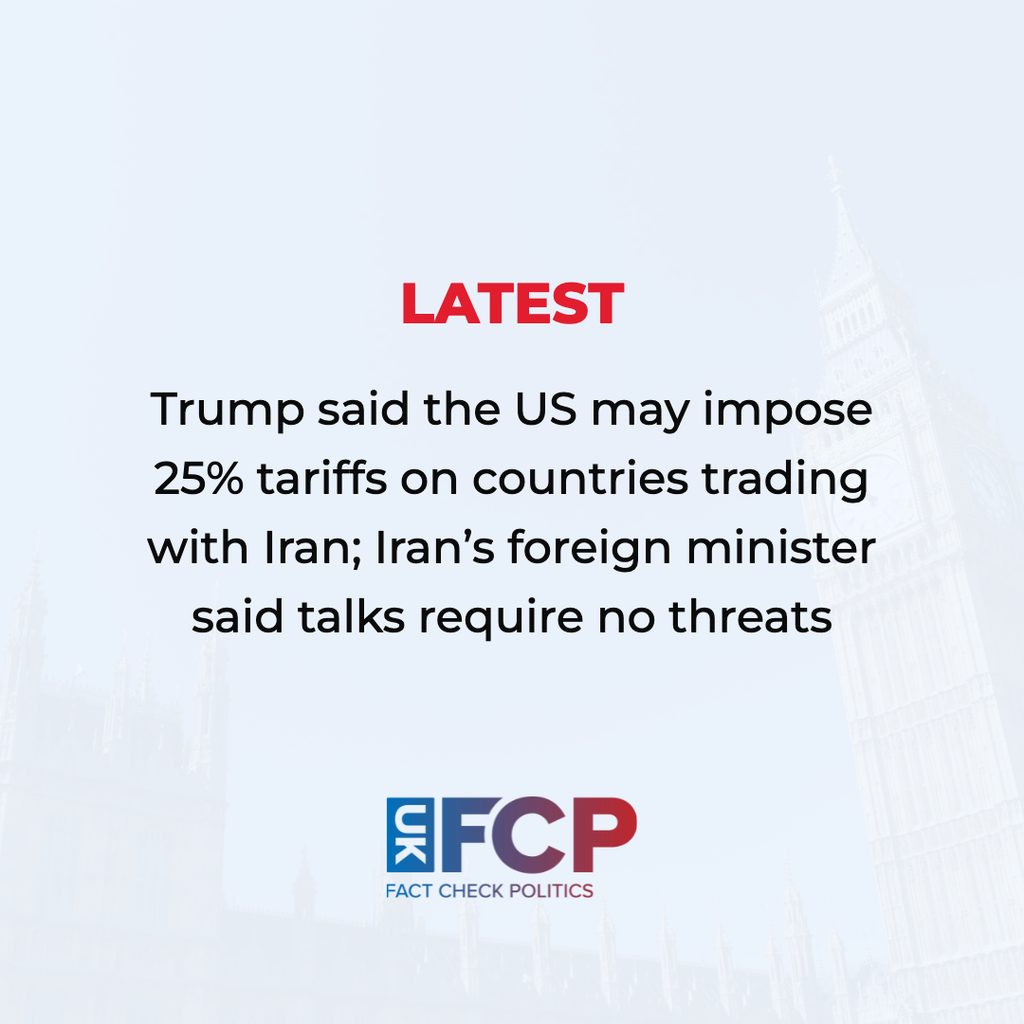
US President Donald Trump has announced plans to impose a 25 per cent tariff on countries that do business with Iran when they trade with the United States, stepping up pressure on Tehran as Iran’s government faces continuing unrest and an extended internet shutdown.
Trump’s comments came after he said on Tuesday night that he was considering a range of “very strong” options against Iran over its handling of protests, without detailing the measures under review. The tariff threat, framed as a penalty on third countries rather than Iran directly, would widen the economic impact of any US escalation if implemented.
Iran’s Foreign Minister Abbas Araghchi, speaking in an interview with Al Jazeera Arabic, said Tehran was prepared to engage in nuclear talks with Washington, but only under specific conditions. “Iran is ready to engage in nuclear talks with the US, provided that it is without threats or dictates,” he said.
Araghchi also issued a warning against military action, referring to earlier strikes. “If Washington wants to test the military option it has tested before, we are ready for it,” he told Al Jazeera Arabic, citing US bombings carried out on three nuclear sites in Iran in June 2025.
The White House signalled that it believes Iran is communicating differently in private. Press Secretary Karoline Leavitt told Fox News that Iran was sending a different message to Trump behind closed doors and said the president was willing to use military force against Iran.
Inside Iran, authorities sought to project strength as thousands gathered in pro-state rallies in Tehran. Supreme Leader Ayatollah Ali Khamenei congratulated participants on social media, with attendance described as in the tens, if not hundreds, of thousands. The rallies came amid heightened tensions following days of protests and a widening crackdown reported by rights observers, though the full scale of unrest has been difficult to verify independently.
Iran has also remained largely cut off from the internet, with the blackout exceeding 100 hours, according to NetBlocks, a global internet connectivity monitor. The prolonged disruption has limited access to information inside the country and made it harder for journalists and observers to confirm events on the ground.
Regional and international reaction continued to build as the situation developed. Omer Celik, spokesman for Turkish President Recep Tayyip Erdogan’s governing AK Party, warned that foreign intervention in Iran could deepen instability. Celik said external involvement could worsen the country’s crisis, as neighbouring states watch for spillover effects across the region.
In Europe, the president of the European Parliament, Roberta Metsola, has prohibited all Iranian diplomats and “any other representatives of the Islamic Republic of Iran” from parliament premises, a move that further tightens political pressure on Tehran and restricts official engagement in one of the European Union’s key institutions. The European Parliament did not immediately provide further detail on the scope or duration of the measure.
Trump’s tariff threat and the mixed signals about possible talks highlight the competing tracks now shaping the US-Iran confrontation: economic pressure, diplomacy and the risk of military escalation. Tehran has repeatedly insisted it will not negotiate under coercion, while US officials have argued that sanctions and other measures are needed to change Iranian behaviour.
It remains unclear how quickly any new US tariff policy could be implemented and which countries might be most affected. Iran maintains commercial ties across Asia, the Middle East and parts of Europe, though many firms and governments have already reduced exposure to Iranian markets due to existing US sanctions.
For now, the standoff is unfolding against the backdrop of domestic turmoil in Iran, an information blackout that has lasted more than four days, and sharp warnings on both sides. Araghchi’s remarks indicated that Tehran is leaving open the possibility of talks, while insisting it will respond to threats, and the White House message suggested the administration is keeping military options on the table as it increases economic pressure.