
🔥JUST IN: Arctic Trade Route OPENS — Trump STUNNED as $740B Slips Beyond U.S. Reach.⚡️
Uploaded Image
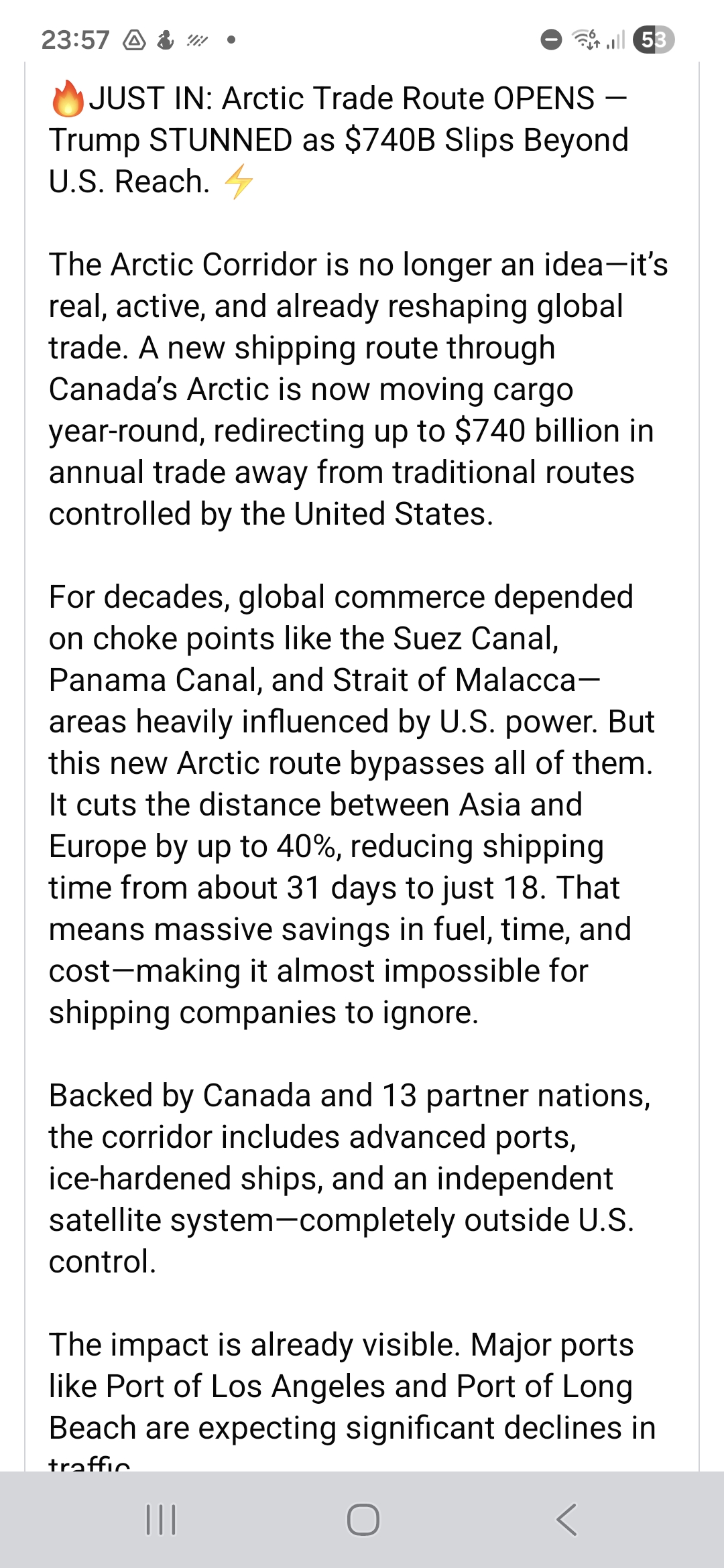
Transcribed Text
The image-text makes several high-impact, time-sensitive claims about a new Canada-led, year-round Arctic shipping corridor already diverting up to $740B of trade, backed by 13 partner nations, equipped with advanced ports/ice-hardened ships and an “independent satellite system”, and already causing expected traffic declines at the Ports of Los Angeles and Long Beach.
Full analysis The complete summary ⌄
The image-text makes several high-impact, time-sensitive claims about a new Canada-led, year-round Arctic shipping corridor already diverting up to $740B of trade, backed by 13 partner nations, equipped with advanced ports/ice-hardened ships and an “independent satellite system”, and already causing expected traffic declines at the Ports of Los Angeles and Long Beach. Targeted web research finds partial support only for narrower, documented realities: Arctic routes can be shorter on some lanes, Canada is pursuing “Arctic corridor”/trade-corridor initiatives, and there are proposals/agreements exploring expanded or even year-round shipping from the Port of Churchill. However, I did not find up-to-date authoritative evidence that a new Canada Arctic route is currently moving international cargo year-round as a general corridor, nor that it is already redirecting $740B annually, nor that it is backed by “Canada and 13 partner nations” with a dedicated independent satellite system. The LA/Long Beach decline claims are supported in other contexts (tariffs/trade disputes), not linked to an Arctic corridor.
What checked out (1)
- Arctic routes can reduce distance/time between parts of Asia and Europe on certain voyages/lanes (often cited around ~30–40% distance savings on some comparisons), though feasibility is highly conditional and often seasonal.
Unverified claims 8 claims ⌄
- “A new shipping route through Canada’s Arctic is now moving cargo year-round.”
- “The Arctic Corridor … is real, active, and already reshaping global trade.” (as a general, large-scale corridor claim).
- “Redirecting up to $740 billion in annual trade away from traditional routes controlled by the United States.”
- “This new Arctic route bypasses [Suez, Panama, Malacca] and therefore slips beyond U.S. reach.” (scope/causality and the ‘beyond U.S. reach’ framing).
- “It cuts the distance between Asia and Europe by up to 40%, reducing shipping time from about 31 days to just 18.” (as a general claim for a Canada-Arctic route; evidence found relates to specific services/claims and not necessarily Canada’s Arctic/Northwest Passage year-round).
- “Backed by Canada and 13 partner nations.”
- “The corridor includes advanced ports, ice-hardened ships, and an independent satellite system—completely outside U.S. control.”
- “Major ports like Port of Los Angeles and Port of Long Beach are expecting significant declines in traffic” due to this Arctic corridor.
Sources & how we checked Search journal, source grades, confidence ⌄
Confidence
Medium — Confidence is medium because the highest-impact assertions (year-round Canada-Arctic cargo corridor now; $740B diversion; 13 partner nations; independent satellite system; LA/LB declines caused by this corridor) were not corroborated by authoritative, up-to-date sources found in targeted searches, while adjacent, narrower facts (Canada pursuing Arctic trade-corridor initiatives; Arctic routes can be shorter under certain conditions; port declines occur for other documented reasons) are supported by reputable sources. Absence of confirming evidence is treated as Unverified rather than False, per guardrails.
Search journal
Canada Arctic shipping route year-round moving cargo new corridor 13 partner nations independent satellite system
Northwest Passage year-round cargo shipping route through Canada Arctic year-round moving cargo
- https://arcticportal.org/shipping-portlet/shipping-routes/northwest-passassage
- https://www.nature.com/articles/s43247-024-01477-6
Arctic Corridor Canada 740 billion annual trade redirected
- https://www.arcticgateway.com/agg-news/newsroom/year-round-shipping-from-port-of-churchill-focus-of-new-agreement
- https://www.saskatchewan.ca/government/news-and-media/2025/july/22/saskatchewan-manitoba-and-arctic-gateway...
Port of Los Angeles Port of Long Beach expecting significant declines in traffic because Arctic route
- https://www.nbclosangeles.com/news/local/ports-of-los-angeles-long-beach-44-percent-drop-in-docked-vessels/3694112/
- https://www.spglobal.com/market-intelligence/en/news-insights/research/west-coast-ports-watch-signs-trade-d...
Government of Canada Arctic Infrastructure Fund trade corridors fund call for proposals