

Pope Leo XIV on Friday deepened the Vatican’s criticism of the US-led war on Iran, denouncing attempts to link Christian faith to military domination in remarks widely interpreted as a rebuke to Defence Secretary Pete Hegseth’s increasingly explicit religious language about the conflict.
In a Holy Thursday homily at St Peter’s Basilica, Leo warned that Christian mission had too often been “distorted by a desire for domination”, calling that impulse “entirely foreign to the way of Jesus Christ”. The Pope did not name Hegseth or President Donald Trump, but his comments came after weeks of appeals from the Trump administration for Christian prayers for the war effort.
The clash has opened an unusually direct divide between the Vatican and Washington over the meaning of religious language in wartime, as the month-old US-Israeli campaign against Iran continues and pressure grows for either escalation or a ceasefire.
Leo’s latest remarks built on a series of increasingly pointed statements during Holy Week. On Palm Sunday, he said God is the “King of Peace” and that God “does not listen” to the prayers of those who wage war or invoke his name to justify violence. Since the conflict intensified, the Pope has repeatedly called for an unconditional ceasefire and a return to dialogue.
Hegseth, by contrast, has framed the war effort in explicitly Christian terms. At a Pentagon worship service on 26 March, the first such service held after the Iran war began, he joined in a prayer asking that “every round find its mark” and for “overwhelming violence of action against those who deserve no mercy”, according to reports of the livestreamed event. He has also repeatedly urged Americans to pray for US forces “in the name of Jesus Christ”.
That language has drawn criticism not only from the Vatican but also from church-state watchdogs, military chaplains and some current and former service members, who say it risks turning a military campaign into a sectarian cause inside one of the world’s most religiously diverse armed forces.
The Pentagon service is now part of a legal challenge by Americans United for Separation of Church and State, which is seeking records relating to the gatherings and alleges that Hegseth has used his office and public resources to advance his personal faith.
The war itself began on 28 February, when the United States and Israel launched large-scale strikes across Iran in an operation Washington calls Operation Epic Fury. Publicly stated US goals have included destroying Iran’s missile forces and naval capacity and preventing it from acquiring a nuclear weapon. Open-source estimates put US losses at about 15 service members killed and more than 500 wounded since the fighting began, with several regional bases damaged in Iranian retaliation.
As the military campaign has widened, so too has the argument over how it is being described.
On 31 March, after visiting US troops in the Middle East, Hegseth refused to rule out the deployment of ground forces, saying the United States could not win a war by telling its adversaries what it would not do. He has also said there will be “no stupid rules of engagement” in the campaign, presenting the operation as a decisive break from the constraints of past US wars.
The Vatican has moved beyond moral appeal to more formal doctrinal criticism. Cardinal Pietro Parolin, the Holy See’s secretary of state, said this week that the war on Iran does not meet Catholic just war standards, making the institutional split with Washington even clearer.
That judgement carries particular weight because Catholic teaching has historically allowed for the possibility of war under tightly defined conditions, while insisting that force cannot be justified by religious triumphalism. Leo’s message has been that even where states claim security objectives, God cannot be used as a warrant for violence.
Support for the Pope’s position has spread across parts of the global Catholic hierarchy. US bishops and other episcopal conferences issued statements on Friday backing Leo’s calls for peace and rejecting what several described as any effort to turn the conflict into a “holy war”.
The White House has pushed back. Press secretary Karoline Leavitt publicly defended Trump’s decisions after Leo’s Palm Sunday remarks and disputed the suggestion that the administration was misusing Christian belief to legitimise military action.
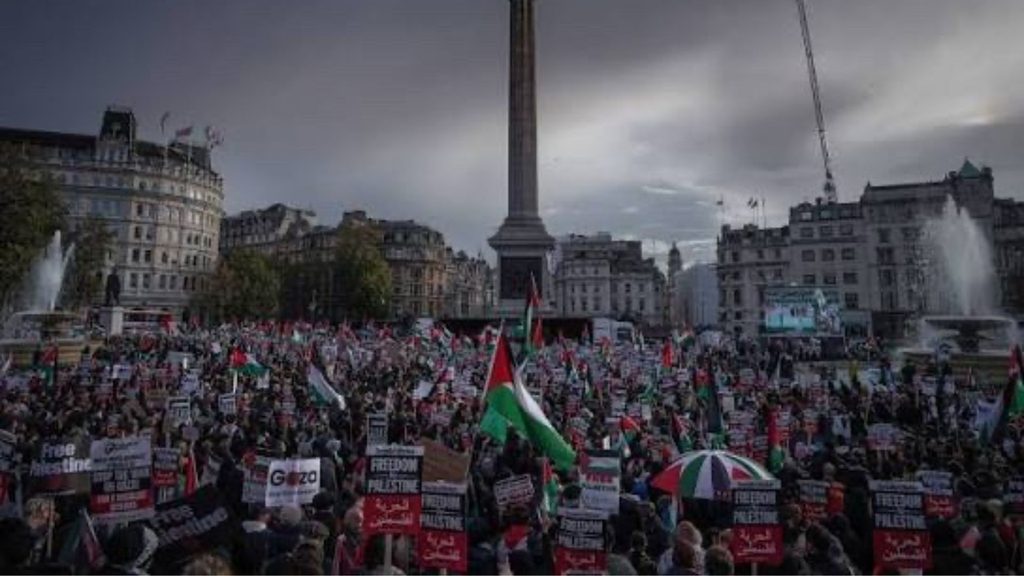
The dispute is unfolding as anti-war protests grow in the United States and as allied governments weigh how far they are willing to support Washington’s campaign. Britain has provided air defence and other support in the region while resisting some US requests for offensive use of British bases, according to previous reporting, a sign of broader unease among partners over the scale and direction of the war.
For Hegseth, the criticism adds to wider scrutiny of his leadership at the Pentagon. Reports in recent days have described complaints from troops and chaplains who say commanders have used religious imagery, including references to God’s plan and apocalyptic themes, in discussing the Iran war. Those accounts have not been fully documented in official Defence Department material, but they have intensified concern over the boundary between private belief and military command.
For Leo, the issue has become one of the defining themes of his first major international crisis as Pope. A former missionary priest with a long record of peace advocacy, he has used the symbolic weight of Holy Week to argue that Christianity cannot be reconciled with the pursuit of domination, however it is packaged politically.
Neither side has shown signs of softening its language.
As fighting continues, the disagreement between one of the world’s most powerful military officials and the head of the Roman Catholic Church has become more than a theological quarrel. It is now part of the broader political battle over how the Iran war is being justified, to troops, to allies and to the public.


Join the Discussion
Have something to say? Join the conversation!
Sign in to share your thoughts and engage with other readers.
Sign In Create AccountNo comments yet
Be the first to share your thoughts on this article!